TGDF Agentic AI Fabric vs. Workflow Automation Platforms
Redefining Enterprise-grade Agentic Intelligence
Today’s AI market is experiencing a surge of marketing claims: many workflow automation vendors are rebranding workflow orchestration platforms as “Agentic AI” solutions — often without technical substance or evidence. This marketing inflation creates confusion in the enterprise space, where decision-makers may mistake enhanced workflow automation for autonomous agentic systems.
Let’s start with clear definitions, then compare the technical realities — and explain why TGDF Agentic AI Fabric was designed specifically for enterprise-class, mission-critical environments.
Workflow Automation vs. Agentic Intelligence
In the whitepaper “Building Effective AI Agents”, Anthropic distinguishes workflows from agents in a way that is useful for enterprise buyers:
- Workflows orchestrate LLMs and tools through predefined code paths — human-designed sequences executed predictably. Ideal for repetitive tasks and predictable processes, but limited when conditions change and complexity rises.
- Agents introduce autonomous intelligence: systems that can reason, adapt, and make decisions in real time based on context, goals, and evolving data — dynamically directing their own process and tool usage, rather than following scripted sequences. This is essential for complex operations and business process automation.
Why Many “Agentic” Market Platforms Are Still Workflow Tools
Platforms such as n8n, Airia, Zapier, Make, Agentforce, or OpenAI AgentKit often position themselves as “Agentic AI”. In practice, they are primarily designed for structured workflow automation (marketing, engagement, customer service): they act as LLM wrappers that connect tools, trigger actions, and execute pre-set logic.
What they call “agents” are typically scoped components (retrieval, summarization, etc.) orchestrated through deterministic pipelines — not autonomous reasoning entities.
In contrast, true agentic AI platforms enable autonomous, context-aware agents that collaborate, adapt, and learn continuously — unlocking a new generation of enterprise operational intelligence.
Purpose and Design Philosophy
The True Purpose of Workflow Orchestration Platforms
Workflow automation and orchestration platforms are designed primarily for individuals and SME business users seeking to automate routine tasks or prototype simple AI workflows. Their value lies in accessibility and ease of use, allowing non-technical users to build automations without deep AI or coding expertise.
Key Benefits
- Low/No-Code Accessibility: Drag-and-drop automation building for non-technical users.
- Workplace Ecosystem Integration: Libraries of connectors (Outlook, Salesforce, Dropbox, WhatsApp, etc.).
- Templates & Community Marketplaces: Pre-built workflows ready to reuse and adapt.
- Easy LLM Access: Managed integration to public LLM APIs (OpenAI, Anthropic, etc.).
TGDF Agentic AI Fabric: Built for Enterprise-Class Agentic Systems
TGDF Agentic AI Fabric was conceived from inception as a multi-agent development fabric for TGDF’s AI engineering teams, to build and deploy enterprise-class, mission-critical use cases for high-stakes environments such as Telecom, Oil & Gas, Banking, and Manufacturing — where reliability, resilience, explainability, and sovereignty are non-negotiable.
Technical Realities and Limitations of Workflow Platforms
Despite accessibility and ease of use, workflow automation platforms face inherent architectural limitations when applied to regulated, high-stakes environments — especially in self-hosted/on-prem deployments where constraints increase further.
Key Technical Limitations
- Static Workflows vs. Adaptive Autonomy: They depend on predefined logic and cannot autonomously adjust objectives, reprioritize, or adapt tool usage based on real-time conditions.
- Fragmented Context Management: Context is transient or localized; memory and reasoning are not shared across workflows — reducing reliability in real operations.
- Limited Multi-Agent Collaboration: Interactions are sequential or controller-driven rather than distributed autonomous collaboration required in complex operations.
- Restricted LLM Integration: Cloud-native versions rely on public APIs; on-prem sovereign LLM integration often requires heavy custom engineering and compromises monitoring/management capabilities.
- Restricted Scalability & Resilience: Reliability, fault tolerance, and security depend on external infrastructure and manual configuration — shifting complexity, cost, and risk to enterprise teams.
Why TGDF’s Agentic AI Fabric Is Unique
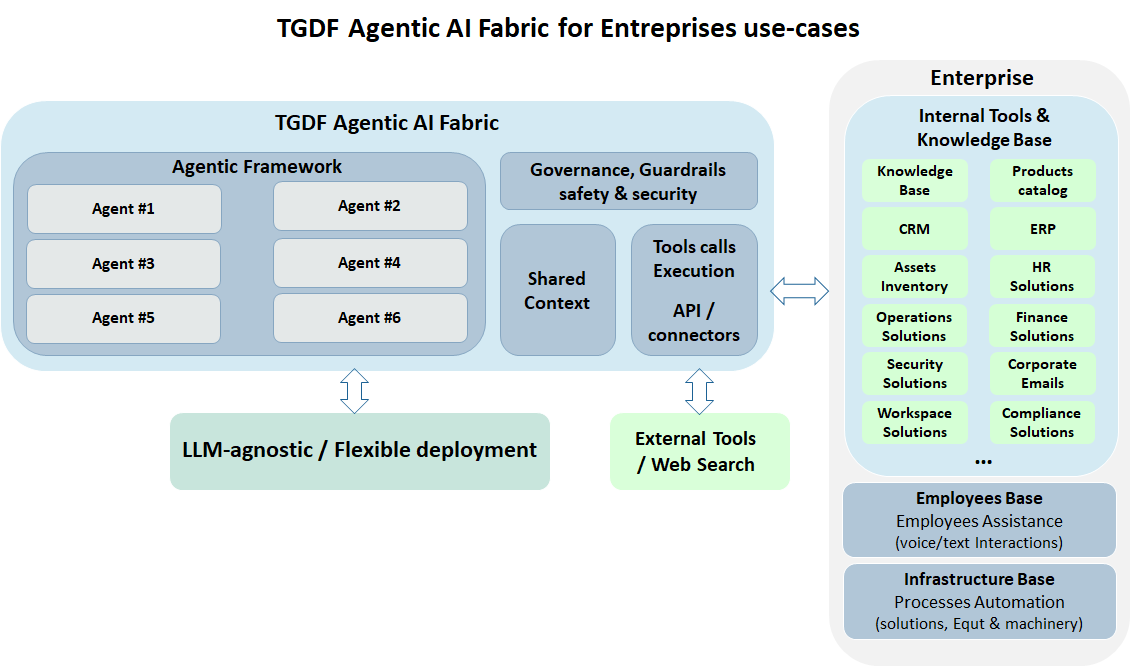
TGDF Agentic AI Fabric embeds intelligence natively within a distributed, event-driven architecture engineered for autonomy, safety, and resilience across multi-agent ecosystems at enterprise scale.
Agents maintain persistent cognitive memory, collaborate dynamically in real time, integrate public or sovereign LLMs without compromise, and manage execution of internal tools or external APIs to deliver mission-critical use cases across complex regulated environments.
TGDF Agentic AI Fabric Core Strengths
- Engineered for Complexity: Lightweight modular architecture for multi-domain interdependent operations.
- Event-Driven Agentic Framework: Agents reason, plan, and adapt dynamically with built-in guardrails and policies.
- Real-Time Context Synchronization: Agents share continuously updated operational context.
- Sophisticated Tools Management: Seamless execution of databases, KBs, file systems, web search, sandboxes, and APIs.
- Integrated Governance & Explainability: Compliance, traceability, decision transparency, privacy, enterprise security.
- LLM-Agnostic: Plug & play with any LLM via adapters (no vendor lock-in) with reliable structured outputs.
- Flexible Deployment: On-prem or private cloud, with non-intrusive Open API integration.
- Sovereign by Design: Full control of data, models, and operations.
Strategic Impact
While market platforms democratize workflow automation, they stop at the threshold of true enterprise-class use cases. TGDF Agentic AI Fabric accelerates enterprise innovation — enabling complex mission-critical operations use cases to reach production faster, with the trust, sovereignty, and scalability enterprises demand.
TGDF Agentic AI Fabric Edge
- Rapid Prototyping & Validation: From idea to validated prototype in days.
- Fast Development: Scalable production-ready use cases in weeks.
- Lower Costs & Risks: Reduced investment risk, faster time-to-market, lower TCO.
Enterprise Use Cases
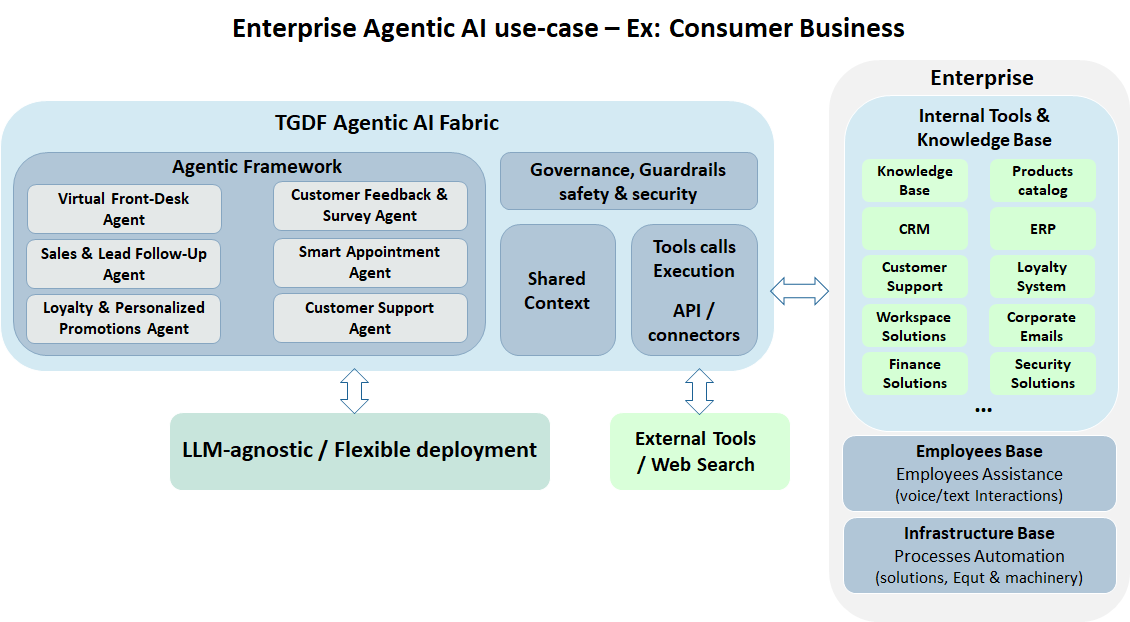
1) Enterprise Agentic AI — Consumer Business (Fabric Alone)
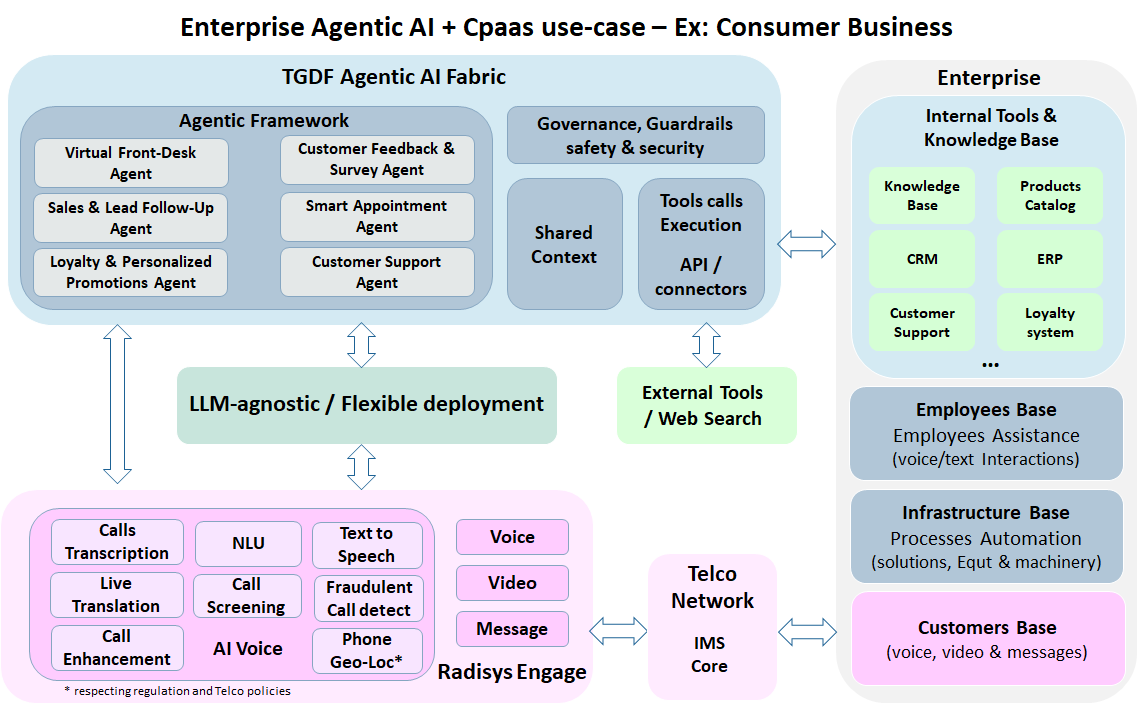
2) Enterprise Agentic AI + CPaaS (Fabric + Radisys CPaaS)
3) Human-Centered Cybersecurity
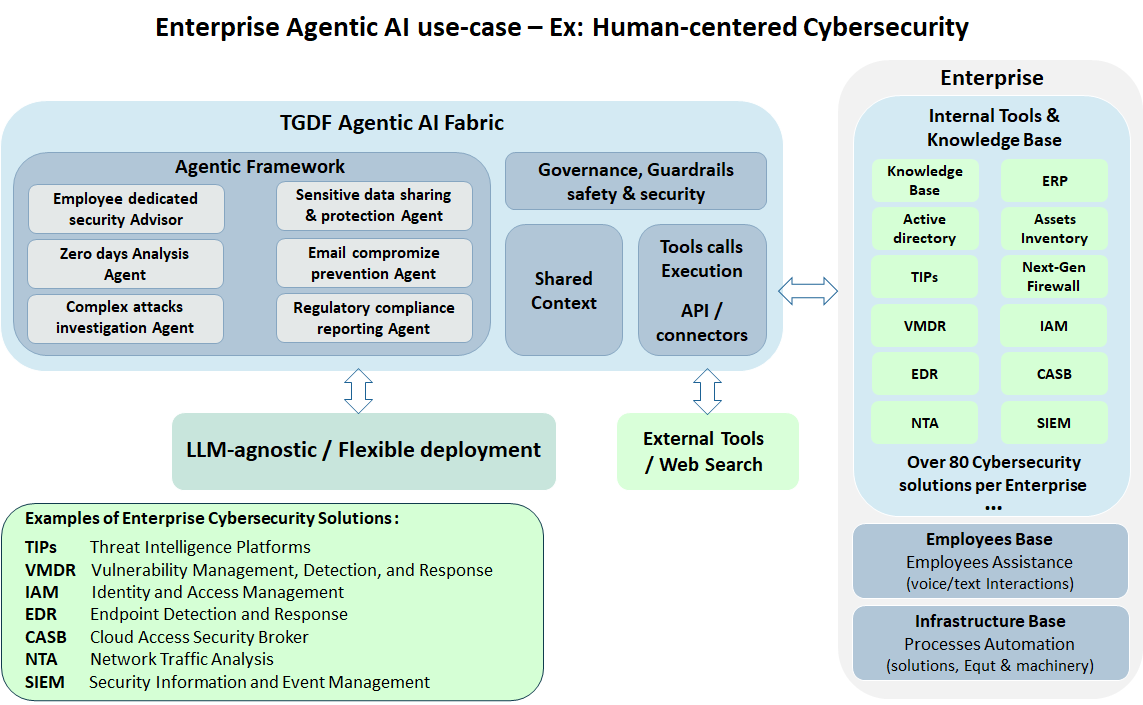
TGDF Agentic AI Fabric = Enterprise Agentic AI Without Limits
A platform engineered to unlock complex, high-value enterprise use cases — faster, safer, and without compromise.
TGDF Agentic AI Fabric: the enterprise AI fabric redefining sovereignty, scale, and impact.